Physicists & Astronomers
Investigates the fundamental laws governing matter, energy, and the universe — running experiments, building theoretical models, or analyzing telescope and particle-collider data — a research-heavy field where most roles beyond entry-level technician work assume a graduate degree.
Salary
- Entry-level
- $82,000
- Mid-career
- $172,500
- Senior
- $274,000
Source: BLS OEWS, May 2025
Job outlook
- Growth, 2025–35
- +7%
- Much faster than average
- Openings each year
- 1,500
- New jobs plus people retiring or moving on
- Jobs in 2025
- 25,600
- +1,900 by 2035
Source: BLS Employment Projections, 2025–35. Growth for all jobs is +3.5%. See the BLS profile
A day on the job
What people in this job typically spend their time doing.
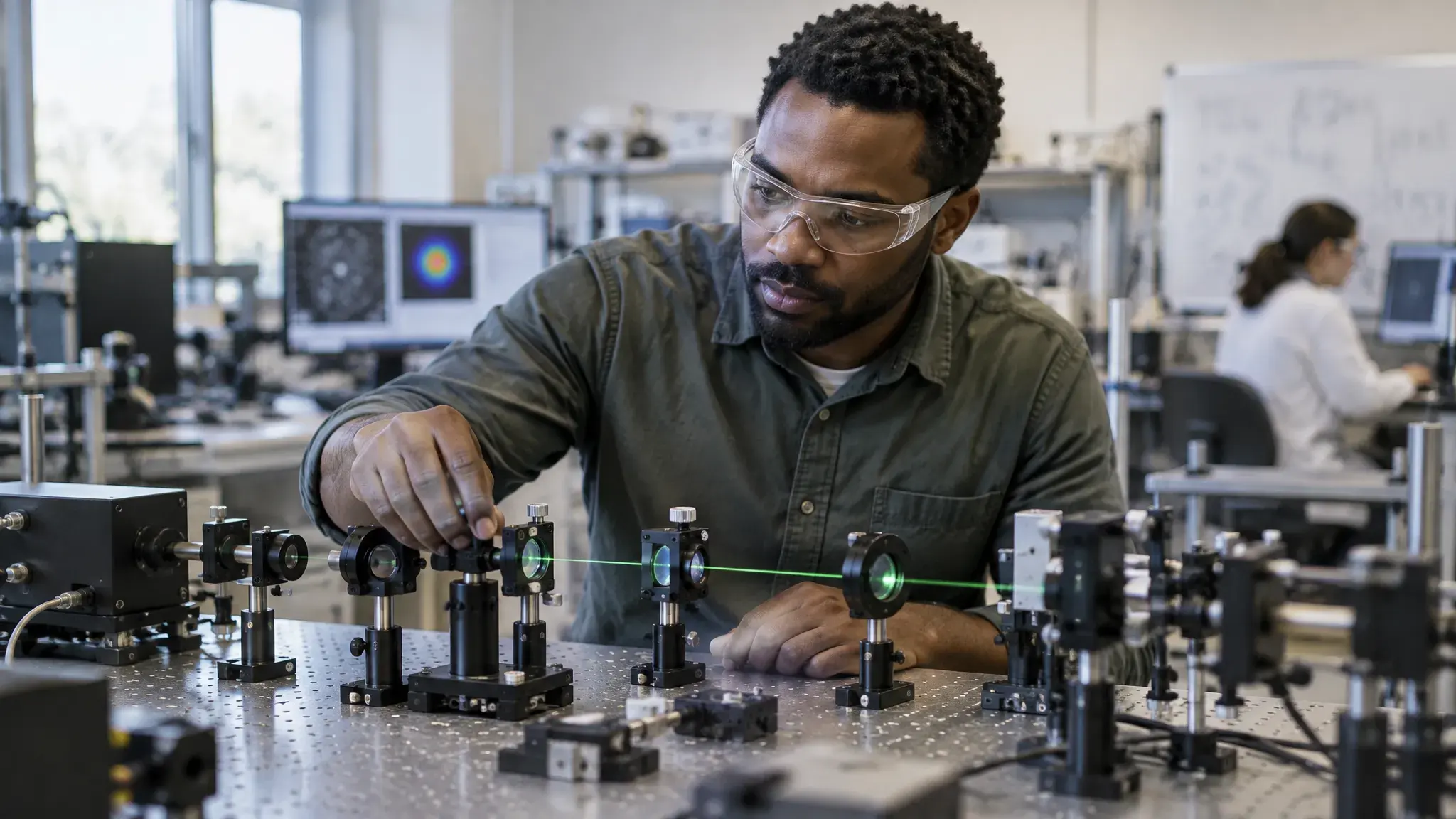
- Run experiments using lasers, telescopes and other scientific equipment
- Analyze research data, often with complex computer calculations
- Build computer simulations and math models of how the physical world works
- Work with other scientists to design and test new equipment and methods
- Write grant proposals to fund research
- Publish results in journals and present at scientific conferences
Adapted from O*NET OnLine (19-2012.00), U.S. Department of Labor, used under the CC BY 4.0 license.
Getting in
A degree is required for this career.
Recommended degrees
Progression
- Research Assistant / Lab Technician
- Physicist (often after a master's or PhD)
- Senior Research Physicist
- Principal Scientist / Observatory or Lab Director
Where this can lead

Top Employers
- National laboratories (e.g. Fermilab, Los Alamos, Lawrence Berkeley) The center of gravity for large-scale physics research, with access to instruments — particle accelerators, telescopes — no university lab can match.
- Research universities Combines teaching with research, usually requiring a PhD and a postdoctoral track record before landing a permanent faculty position.
- Semiconductor and aerospace companies Applied physics roles in industry tend to pay more than academia and skip the tenure track, at the cost of published, open-ended research.
Networking & job search

- The American Physical Society (APS) runs student chapters and a large annual conference where undergraduates present alongside working physicists.
- National lab summer programs (Fermilab, Los Alamos, NASA centers) are among the strongest ways to build a research network before applying to grad school.
- The Society of Physics Students (SPS) connects undergraduates directly with mentors already working in national labs, observatories, and industry research roles.
Example trajectories
Priya
Physics degree → research assistant at a national lab → PhD in condensed matter physics → research physicist at a semiconductor company, 8 years in.